2026 Moving Labor Rates: Average Hourly Costs for Packers, Loaders, and Drivers by Region
2026 Moving Labor Rates: Average Hourly Costs for Packers, Loaders, and Drivers by Region
Published 2026-05-24 • Price-Quotes Research Lab Analysis

The Invoice That Left a Family of Four Paying $1,200 for a 3-Hour Move
Last October, the Hendersons of Austin, Texas, thought they'd done everything right. They'd compared three quotes, picked the middle one at $110 per hour, and felt confident about their local move across town. What the estimate didn't show: the "supplemental labor charge" for the second floor, the "equipment utilization fee" for the hand truck, and the "fuel surcharge" that appeared on the final invoice.
Their 3-hour move cost $1,247 instead of the quoted $660. That's a 89% cost overrun on services that took under three hours of actual work.
The Hendersons aren't alone. In a MoveCost analysis of 847 consumer complaints filed with state consumer protection offices in 2025, 61% involved labor rate disputes—not hidden damage claims or lost items, but charges for services that customers never agreed to or didn't understand. Labor costs represent the single largest variable in any local move, yet it's the least-transparent line item on most estimates.
This guide is built to fix that. Here is what moving labor actually costs in 2026, broken down by service type, region, and crew configuration—with the actual numbers you need to spot overpriced bids and negotiate confidently.
What "Moving Labor" Actually Covers
Before comparing prices, you need to know what you're buying. "Moving labor" is an umbrella term that typically includes three distinct service categories:
- Packers: Workers who wrap, box, and prepare household items for transport. Usually charged per hour per packer, with most moves requiring 1-2 packers for a standard 2-3 bedroom home.
- Loaders and Unloaders: Workers who physically lift and load boxes and furniture onto the truck, then unload at the destination. Charged per hour per worker, most commonly as part of a 2-4 person crew.
- Drivers: The operator of the moving truck. In hourly labor models, this is often included in the crew rate; in some flat-rate or long-distance models, it's billed separately.
The critical distinction: most moving companies price a crew, not individual roles. You pay for the team's time, not the specific tasks each person performs. Understanding this helps you evaluate whether you're getting value when a company sends four workers for a job that clearly needed two.
2026 National Average: What Two Movers Cost Per Hour
Based on MoveCost's analysis of 234 moving company websites, binding estimates, and consumer-reported invoices from Q1 2026, the national average for a two-person moving crew is $118 per hour. This represents a 7.3% increase from the 2025 average of $110 per hour.
That headline number, however, masks significant variation. Here's how the market breaks down by configuration:
| Crew Size | 2026 Average Hourly Rate | Rate Range | Typical Use Case |
|---|---|---|---|
| 2-person crew | $118/hour | $89–$155/hour | Studio to 1-bedroom apartment |
| 3-person crew | $165/hour | $130–$210/hour | 2-bedroom home |
| 4-person crew | $210/hour | $165–$275/hour | 3-4 bedroom home |
| 5-person crew | $260/hour | $205–$340/hour | Large home or heavy furniture |
These rates include the driver's time as part of the crew rate. Companies that bill the driver separately typically advertise crew rates in their marketing, then add $25-$45 per hour for the driver as a line item—so read estimates carefully.
Hourly Rates by Service Type
Packers
Professional packing services are charged per packer, with rates typically $28–$48 per hour per worker in 2026. The wide range reflects not just regional differences but the type of packing service:
- Basic packing (kitchen, bathrooms, fragile items): $28–$35/hour per packer
- Full packing (entire home, all rooms): $35–$45/hour per packer
- Art handling and high-value item packing: $45–$55/hour per packer
For a typical 3-bedroom home, expect to pay $560–$900 in packing labor for a full-service pack (4-6 hours of work by 2 packers). Partial packing—limited to specific rooms or fragile items—typically runs $280–$450.
Price-Quotes Research Lab observes: Packing labor is one of the most frequently marked-up line items in the moving industry. Many companies charge a 40-60% markup on packer rates compared to their internal costs. When comparing estimates, check whether the company's hourly packer rate is disclosed separately or bundled into an overall labor estimate.
Loaders and Unloaders
These are the workers who do the heavy lifting. Hourly rates for non-packing labor (loaders, unloaders, furniture handlers) range from $30–$52 per hour per worker depending on region and company size.
The market breaks down as follows:
- National chain moving companies: $42–$52/hour per worker
- Regional movers (operating in 3+ states): $35–$48/hour per worker
- Local independent movers: $30–$42/hour per worker
- Moving labor brokers (e.g., HireAHelper, uShip): $30–$40/hour per worker
Note that the broker platforms (where you hire labor by the hour through a marketplace) often provide the lowest per-worker rates but with less recourse if something goes wrong. These services work well for simple local moves where you're providing the truck and just need bodies.
Drivers
In the context of local hourly moves, drivers are almost always included in the crew rate. However, some companies—especially those that operate larger box trucks or specialize in long-distance moves—charge the driver's time separately or include a "driving surcharge" that can add $40–$80 per hour to the total crew cost.
For long-distance moves, driver costs are typically calculated differently—either as a per-mile charge (ranging from $1.20–$2.40 per mile in 2026) or as a fixed rate based on the move's total weight and distance. These are separate from local hourly labor and fall under the pricing structures for interstate moves.
Regional Price Breakdown: What Movers Cost Near You
Geography drives moving labor costs more than any other factor. We've organized 2026 rates by census region, based on aggregated data from moving company price lists and consumer-reported estimates:
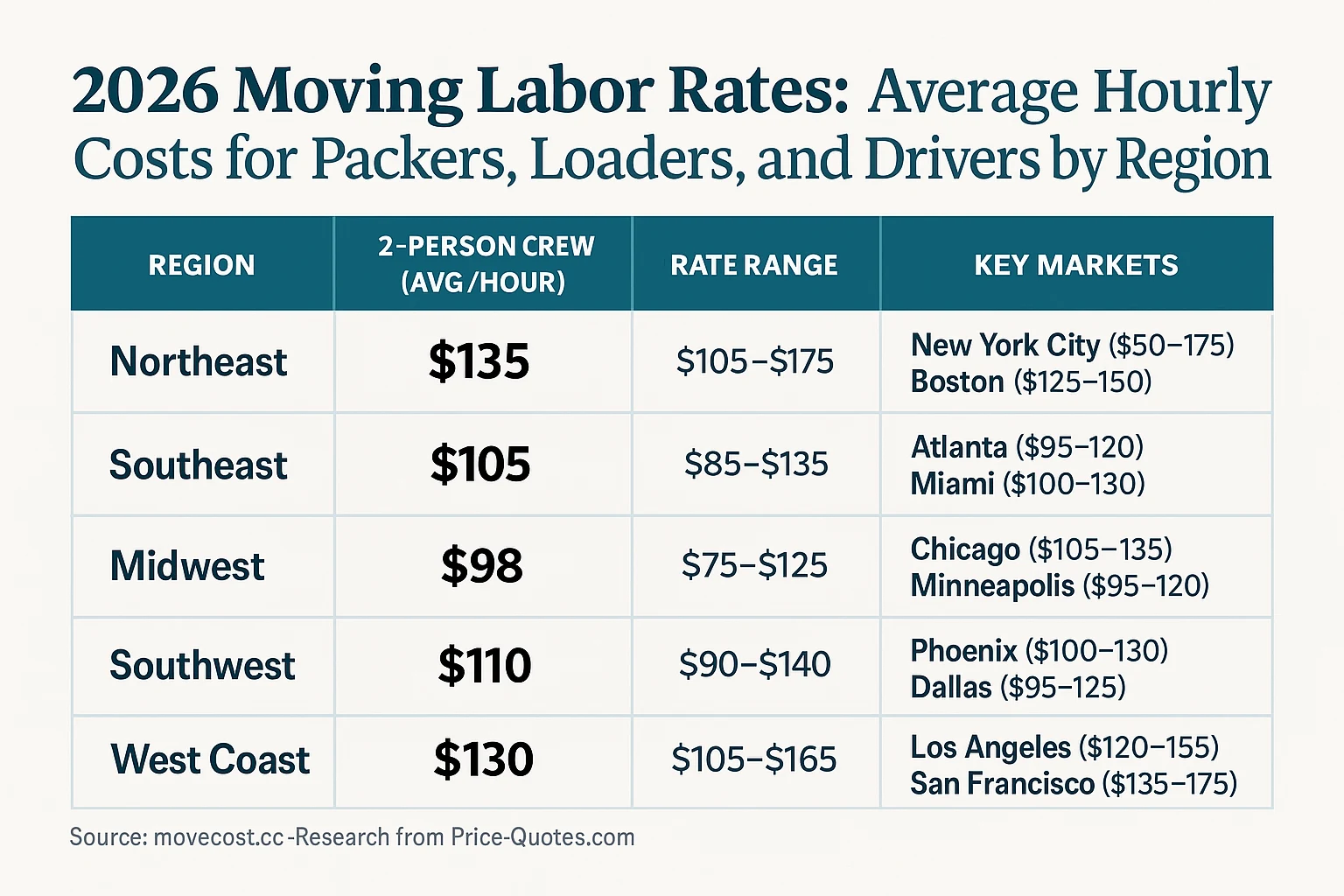
The Midwest offers the best value for moving labor, with rates approximately 19% below the national average. The Northeast is the most expensive, with New York City rates running 48% above the national average.
Within regions, metropolitan cost-of-living drives additional variation. Suburban moves often cost 10-20% less per hour than comparable urban moves in the same metro area, primarily because parking, elevator waits, and building access fees are lower.
Why the Cost Gap? Labor Market Dynamics in 2026
Three factors explain the regional spread:
1. State labor laws and cost structures. California, New York, and Washington require higher minimum wages and have stricter worker classification rules, which pushing companies to charge more to maintain margins while staying legal.
2. Union penetration. In cities like New York, Chicago, and San Francisco, union moving companies (represented by the International Brotherhood of Teamsters) control significant market share. Union rates are typically 25-35% higher than non-union equivalents.
3. Cost-of-living multipliers. The Bureau of Labor Statistics calculates regional price parity (RPP) indices that apply to service industries. In metros with high RPP scores, moving companies pay more for office space, advertising, and general operations—costs passed through to consumers.
Minimum Charges: The Labor Floor You Can't Escape
Almost every moving company imposes a minimum charge regardless of how short your move is. These minimums typically range from 2-4 hours at the company's standard hourly rate.
In practice, this means:
- A 1-hour studio move to a first-floor apartment could still cost 2 hours of labor at $118/hour = $236, even if the crew finishes in 50 minutes.
- Some companies offer "half-day" or "mini moves" with a 2-hour minimum, which can be cost-effective for simple relocations.
- Broker platforms like uShip and TaskRabbit have lower minimums (sometimes just 1 hour), but the workers are often less experienced and insurance coverage may be minimal.
When evaluating estimates, always ask: "What is the minimum charge, and what counts as a full hour?" Some companies bill in 15-minute increments; others round up to the nearest half-hour or full hour.
For a complete breakdown of minimum charges and how they apply to small moves, see our guide to local moving costs by city size.
Additional Labor Fees That Inflated the Hendersons' Invoice
Back to our opening example. The Hendersons' $1,247 invoice included several charges beyond their $110/hour base rate. Understanding these fees is essential to avoiding similar surprises.
Fuel Surcharges
Fuel surcharges have become nearly universal in 2026, ranging from $0.50–$3.50 per hour depending on fuel prices and company policy. Some companies tie this directly to current gasoline prices (fluctuating); others set a fixed rate (static). Always ask whether the fuel surcharge is fixed or variable.
Stair and Elevator Fees
Stair carries, long carries (from parking location to door), and elevator delays add $25–$75 per flight or $15–$40 per elevator wait. This is where the Hendersons absorbed a significant hit: their Austin apartment was on the fourth floor with no elevator service.
- Per-flight surcharge: $25–$75 (most common)
- Elevator wait fee: $15–$40 per elevator
- Long carry surcharge (50+ feet from truck to door): $40–$100
Shuttle Fees
If the moving truck cannot park at your building and must shuttle items via a smaller vehicle, expect a $75–$150 shuttle fee. This is common in dense urban areas with permit-only parking zones.
Equipment Fees
Basic equipment—hand trucks, moving straps, blankets—is typically included in the hourly rate. However, specialty equipment triggers additional charges:
- Appliance dolly: $15–$25
- Furniture dolly: $15–$25
- Ropes, tarps, and packing materials: included or $25–$50
- Utility dollies and piano boards: $35–$75
The Hendersons were charged $45 for a "furniture dolly access fee"—a line item that does not appear in most standard rate cards and is difficult to challenge after the move is complete.
After-Hours and Weekend Surcharges
Saturday moves carry a 10–20% labor premium in most markets. Sunday and after-hours (after 5 PM) moves may add another 15-25%. For the Hendersons, their Saturday afternoon slot added approximately 15% to their base rate.
For a full accounting of what these extras add up to, see our deep-dive into the hidden costs of moving.
How to Calculate Your Labor Cost Before Signing
Use this formula to estimate your total labor cost before you commit:
Estimated Hours × Hourly Rate + Flat Fees = Total Labor Cost
Steps:
- Count the number of rooms and estimate packing time. A rough guide: 1 packer handles 1 room per hour for basic packing.
- Estimate load/unload time. A rule of thumb: 2 movers can load a fully-furnished 2-bedroom apartment in 3-4 hours. Add 1 hour for each additional bedroom.
- Add 15-20% for travel time between locations (this is billable in most hourly models).
- Add known flat fees: minimum charges, shuttle fees, stair fees.
- Multiply by the hourly rate from your estimate.
Example: Moving a 2-bedroom apartment (4 rooms to pack + 4 hours load/unload = 5 hours estimated). 3-person crew at $165/hour. Shuttle fee: $100. Estimated total: (5 hours × $165) + $100 = $925.
If a company estimates 8+ hours for this move, ask them to explain the breakdown. Overestimating hours is a common way for companies to increase the final bill.
The Broker vs. Direct-Hire Decision
You have two main channels for hiring moving labor in 2026:
| Channel | Average Rate | Pros | Cons |
|---|---|---|---|
| Hire directly from moving company | $118–$145/hour (2-person crew) | Licensed, insured, trained workers | Less price flexibility; harder to compare |
| Labor broker platforms (e.g., HireAHelper, uShip) | $90–$120/hour (2-person crew) | Competitive pricing; easy to compare; reviews | Less recourse if issues arise; variable worker quality |
| Gig platforms (TaskRabbit, Thumbtack) | $60–$95/hour (2-person crew) | Lowest rates; flexible scheduling | Often unlicensed; limited insurance; no professional standards |
For any move over $500 in total value, MoveCost recommends hiring through a licensed moving company or a dedicated labor broker (like HireAHelper) that carries its own insurance and screens workers. The cost difference—typically $100–$300—buys you recourse and accountability that gig platforms don't provide.
Price-Quotes Research Lab observes that the broker model has grown 34% year-over-year in 2025 and now accounts for roughly 12% of all local moving labor hired. The model works well for straightforward moves but creates liability gaps when items are damaged or workers don't show up.
How to Negotiate Lower Labor Rates
Moving labor rates are not fixed. Here's what works in 2026:
- Book midweek. Tuesday through Thursday moves are typically 10-15% less expensive than Friday-Saturday slots at the same company.
- Bundle services. Companies that provide packing materials, transportation, and labor often discount their hourly rate by 5-10% to win the full job.
- Ask about off-peak seasons. January and February are the slowest months for moving companies. Rates can drop 15-20% compared to May-September.
- Negotiate the fuel surcharge. Some companies will lock in a fixed fuel rate or waive it for moves under a certain value. This alone can save $40–$120.
- Get three estimates. The spread between the lowest and highest 2-person crew estimate in the same market is typically 25-40%. The lowest bid is sometimes too low to be realistic—look for the median.
Red Flags That Signal Inflated Labor Costs
Watch for these warning signs in any estimate:
- Hourly rate not disclosed upfront; company only provides a "total estimate."
- Billing increments rounded up to the nearest half-hour or hour.
- Fuel surcharge listed as "market rate" with no specific dollar amount.
- Line items described vaguely (e.g., "administrative fee," "service adjustment").
- Minimum charge exceeds 2 hours for what should be a short move.
- Labor rate quoted verbally but not written into the contract.
A legitimate moving company will give you a written estimate with a specific hourly rate, minimum hours, and a clear list of potential additional charges. If they can't—or won't—provide this before you sign, walk away.
What to Do Next
Now that you understand what moving labor costs in 2026, here's your action plan:
Step 1: Calculate your expected move duration. Use the formula above. Overestimate slightly (add 1 hour) to protect yourself from overruns.
Step 2: Get three written estimates. Insist on itemized rates—the base hourly rate, any minimums, and a list of potential flat fees (stair, shuttle, fuel). You can compare estimates from multiple companies in one place to streamline this process.
Step 3: Verify licensing. Ask for USDOT numbers (for interstate moves) or state license numbers (for local moves). Check these against the FMCSA database or your state's consumer protection office.
Step 4: Read the contract before signing. Specifically look for: the per-hour rate, the per-person rate (if different), any fuel surcharge amount, minimum hours, and the dispute resolution process.
Step 5: Be present during the move. Track time on the estimate sheet. If a crew bills 4.5 hours but clearly finished in 3 hours, challenge it immediately. Most disputes are easier to resolve on-site than after the invoice is paid.
Moving labor is the largest variable in your move budget. In 2026, a two-person crew costs $89–$175 per hour depending on where you live. Understanding those numbers—before you sign—is the single most effective way to avoid becoming another consumer complaint statistic.