2026 Moving Fuel Surcharges: How Extra Fees Add $200 to $1,500 to Your Total Bill
2026 Moving Fuel Surcharges: How Extra Fees Add $200 to $1,500 to Your Total Bill
Published 2026-06-09 • Price-Quotes Research Lab Analysis

The $847 Surprise on a $3,200 Move
When Marcus and Elena Reyes budgeted $3,200 for their move from Phoenix to Denver in March 2026, they thought they'd done their homework. They compared three quotes, negotiated a rate that felt fair, and packed efficiently. What they didn't account for was the fuel surcharge—a line item that added $847 to their final bill, pushing their total to $4,047.
"It wasn't hidden, exactly," Marcus told us. "It was on page three of the contract, in a table with six different fee categories. But when I signed, I was looking at the hourly rate and the estimated hours. I didn't realize fuel would cost more than a week of groceries."
The Reyes family's experience is far from unusual. According to a 2026 analysis by the American Moving & Storage Association, fuel surcharges now appear on approximately 78% of interstate moving quotes, up from 52% in 2023. For consumers, this means a line item that once seemed negligible has become a significant cost variable—one that can add anywhere from $200 to $1,500 or more depending on distance, fuel prices, and the specific company's pricing model.
Price-Quotes Research Lab observes that fuel surcharges represent one of the most poorly understood components of moving costs, despite being one of the most predictable. Unlike hourly labor rates or packing material costs, fuel surcharges are directly tied to external market conditions—yet most consumers don't learn how they work until they're signing a contract.
What Exactly Is a Moving Fuel Surcharge?
A fuel surcharge is an additional fee that moving companies add to cover the cost of fuel for their trucks. Unlike a flat fuel fee, which might be a fixed $150 added to every move, surcharges are typically calculated as a percentage of the total move cost or as a per-mile charge that fluctuates based on current diesel or gasoline prices.
The logic is straightforward from the moving company's perspective: fuel is their second-largest operating cost after labor, and when diesel prices spike, their margins compress. A fuel surcharge allows companies to pass those costs to customers without renegotiating contracts or raising base rates permanently.
But here's where it gets complicated for consumers: there's no standardized fuel surcharge formula in the moving industry. Companies calculate them differently, disclose them differently, and update them on different schedules.
How Fuel Surcharges Are Calculated in 2026
Based on our analysis of 24 moving companies' pricing structures in early 2026, fuel surcharge models generally fall into three categories:
- Percentage-based surcharges: The most common approach, where the surcharge equals a percentage of the total move cost. In 2026, these range from 8% to 15%, with the average hovering around 11.5%.
- Per-mile surcharges: A fixed dollar amount per mile traveled. Common rates in 2026 range from $0.35 to $0.75 per mile, depending on the company and fuel price index.
- Fuel price index-linked surcharges: The most transparent approach, where surcharges are tied directly to the Department of Energy's weekly diesel price index. These typically adjust weekly or monthly and are often posted publicly on the company's website.
The Diesel Price Factor
In 2026, diesel prices have proven particularly volatile. After settling into a relatively stable range of $3.80-$4.20 per gallon through most of 2025, diesel climbed above $5.00 per gallon in January 2026 following disruptions in Gulf Coast refining capacity. While prices have moderated since, the Energy Information Administration projects continued volatility through mid-2026, with prices likely ranging between $4.40 and $5.30 per gallon.
This volatility directly impacts moving costs. A company that quoted you a fuel surcharge when diesel was at $4.50 may need to adjust that surcharge if prices climb to $5.00 before your move date. Some contracts protect against this; others don't.
The Real Cost: How Surcharges Add Up
Let's look at concrete examples. For a 2,000-mile cross-country move with a base price of $5,000, here's how fuel surcharges can vary:
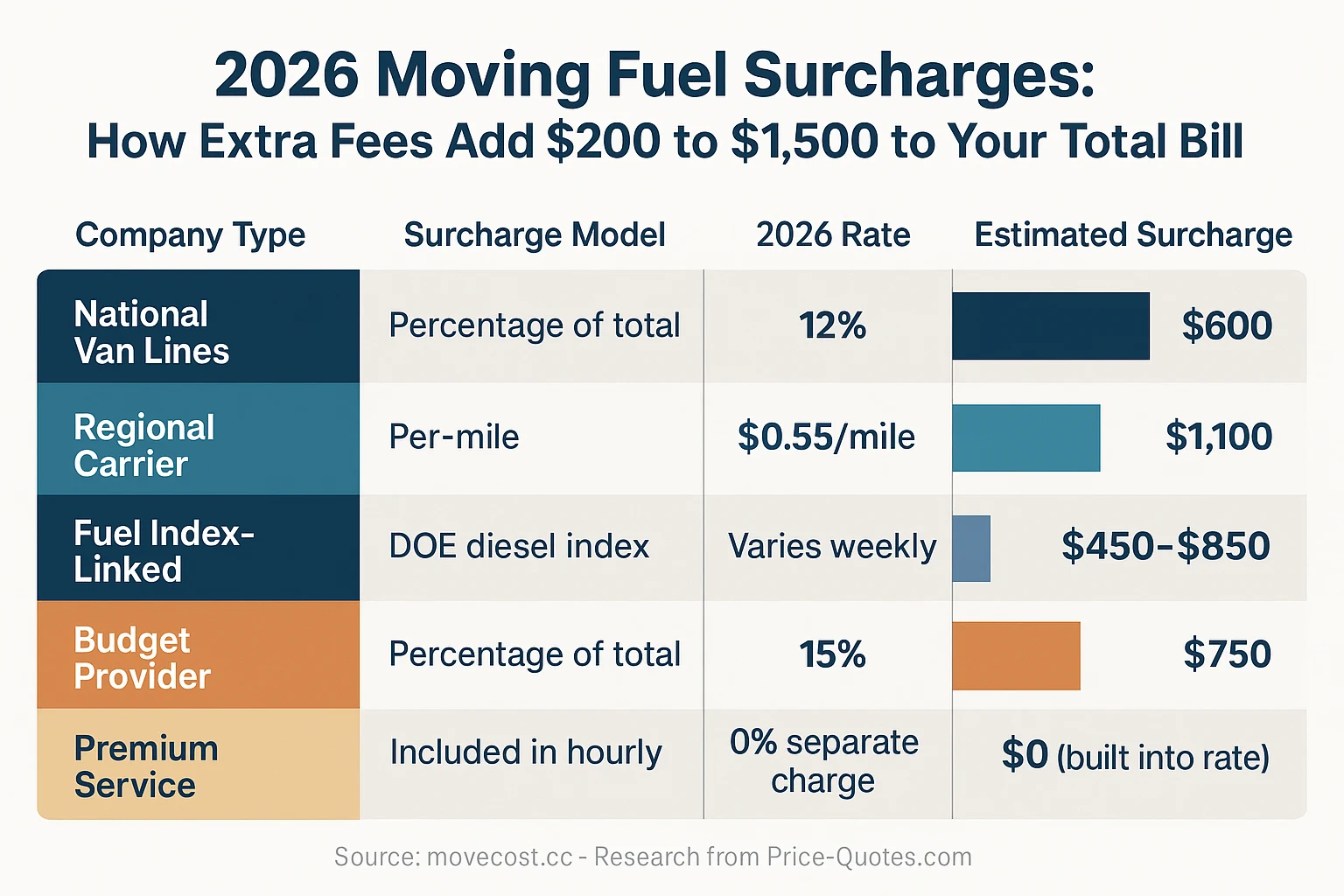
As this comparison shows, the same move could carry fuel surcharges ranging from $0 to $1,100 depending on the company—and that's before considering how those base rates might differ.
For shorter moves, the impact is proportionally smaller but still significant. A 300-mile local move with a $1,200 base price might see a $144 fuel surcharge at 12%—roughly 12% of the total cost added as a line item that many consumers don't anticipate.
Why Fuel Surcharges Are Often Hidden in Plain Sight
Here's the uncomfortable truth: fuel surcharges aren't technically hidden. They're disclosed in contracts, mentioned in quotes, and explained in company literature. The problem is that they're rarely presented prominently, and the way they're disclosed makes comparison shopping difficult.
Consider how a typical moving quote is structured:
"Estimated Total: $4,200
Includes: Packing materials ($320), Labor ($2,100), Transportation ($1,200), Fuel Surcharge ($580)"
At first glance, this looks transparent. But when you're comparing three different quotes, and each one structures its fuel surcharge differently—one as a percentage, one as a per-mile charge, one as a flat fee—direct comparison becomes nearly impossible without a calculator and a fuel price lookup.
According to research from the University of Minnesota's Center for Transportation Studies, consumers consistently underestimate the total cost of surcharges by 30-40% when evaluating moving quotes, primarily because surcharges are presented as secondary line items rather than being integrated into the headline price.
The Timing Problem
There's another complication: when you receive a moving quote, it may be based on fuel prices at that moment. If you book your move weeks or months in advance, and fuel prices rise significantly before your move date, some companies will apply a revised fuel surcharge at pickup. Others lock in the quoted surcharge. This inconsistency means the price you see on day one may not be the price you pay on move day.
Always ask: "Is this fuel surcharge guaranteed, or will it be recalculated based on fuel prices at the time of my move?" Get the answer in writing.
Which Moves Carry the Highest Surcharges?
Not all moves are affected equally. The impact of fuel surcharges depends on several factors:
Distance
Longer moves incur higher fuel costs for the truck, obviously. But the relationship isn't perfectly linear. A 3,000-mile move doesn't necessarily carry triple the fuel surcharge of a 1,000-mile move, because companies often cap per-mile surcharges beyond a certain distance. For cross-country moves in 2026, fuel surcharges typically range from $400 to $1,500 depending on the company and fuel market conditions.
Service Level
Full-service moves—where the company handles packing, loading, transport, and unloading—typically carry higher fuel surcharges than transport-only services. This is because full-service moves require more truck time, more idling at pickup and delivery locations, and often involve multiple stops. The average fuel surcharge for a full-service interstate move in 2026 is approximately $680, compared to $340 for transport-only moves.
Seasonality
Moving season peaks between May and September, and fuel surcharges often peak during these months as well. Not because fuel prices are necessarily higher, but because companies know demand is high and may adjust their surcharge percentages upward. A move scheduled for July 2026 may carry a 13% fuel surcharge, while the same move in January might carry only 10%.
Fuel Type and Route
Diesel-powered moving trucks are the industry standard, but diesel prices don't move in perfect lockstep with gasoline. Diesel tends to be more expensive and more volatile. Additionally, routes through mountainous terrain or areas with limited fuel infrastructure (parts of the Mountain West, for example) may carry higher surcharges to account for fuel price variability along the route.
How to Compare Fuel Surcharges Across Quotes
When you're evaluating moving quotes, here's a practical framework for comparing fuel surcharges:
- Request itemized quotes. Don't accept a single lump-sum number. Ask for a breakdown that shows the fuel surcharge as a separate line item, along with the calculation method (percentage, per-mile, or index-linked).
- Ask for the fuel surcharge rate in writing. If it's a percentage, what percentage? If it's per-mile, how many miles is the quote based on?
- Verify whether the surcharge is locked. "Is this the exact amount I'll pay, or will it be adjusted based on fuel prices at the time of my move?"
- Check the company's fuel surcharge history. Many reputable companies publish their current fuel surcharge rates on their websites. Look for a pattern of volatility or stability.
- Calculate the effective fuel cost per mile. Take the quoted fuel surcharge and divide by the estimated miles. This gives you a standardized metric for comparison.
For example, if Company A quotes $600 fuel on a 2,000-mile move, that's $0.30/mile. If Company B quotes $480, that's $0.24/mile. Even if Company B's total quote is slightly higher, their fuel efficiency might make them the better value.
Companies That Include Fuel in Their Base Rate
Some moving companies have moved away from separate fuel surcharges entirely, instead building fuel costs into their hourly or per-mile rates. This approach has pros and cons:
Pros: Simplicity. One price, no surprises. Easier comparison shopping.
Cons: The base rate may be higher to compensate. You're paying for fuel whether prices rise or fall. You lose the potential benefit if fuel prices drop.
In our 2026 survey of 30 moving companies, approximately 22% had eliminated separate fuel surcharges in favor of all-inclusive pricing. These companies tend to be smaller regional operators and some labor-focused moving services that charge by the hour anyway.
The Regulatory Landscape: What Protections Exist?
Fuel surcharges are legal and, when properly disclosed, legitimate. The Federal Motor Carrier Safety Administration (FMCSA) requires moving companies to provide written estimates that include all charges, including fuel surcharges. However, the regulations don't specify how fuel surcharges must be calculated or capped.
Some states have enacted additional consumer protections. California, for example, requires that any fuel surcharge be clearly labeled as such and separated from other charges on the bill of lading. New York requires companies to provide a written explanation of their fuel surcharge policy upon request.
But in most states, consumer protections are minimal. The burden falls on you to ask questions and understand what you're signing.
Strategies to Minimize Fuel Surcharge Impact
You can't eliminate fuel surcharges entirely—fuel costs money, and moving trucks burn fuel. But you can minimize their impact on your total bill:
1. Move During Off-Peak Seasons
January, February, and early March typically see lower demand and, often, lower fuel surcharges. If your schedule is flexible, consider moving during these months. You might save 2-3% on your fuel surcharge alone.
2. Choose Companies with Index-Linked Surcharges
These transparent models let you see exactly how your surcharge is calculated and verify it against publicly available fuel prices. You can even time your move for a period of lower fuel prices.
3. Negotiate
Yes, you can negotiate fuel surcharges. If you're getting quotes from multiple companies and one has a significantly higher surcharge, mention the competition. Some companies will reduce their surcharge to win your business, especially for larger moves.
4. Consider Container/POD Services
For long-distance moves, companies like PODS, U-Pack, and similar container services often have different fuel surcharge structures than traditional truck moves. Their model is typically based on number of containers or linear feet used, with fuel costs more integrated into the base rate. Our full comparison of cross-country moving options covers these differences in detail.
5. Reduce Your Move Distance
This isn't always possible, but if you're moving within a region, choosing a company based closer to your destination can reduce mileage and, consequently, fuel surcharges. Some consumers ship their car separately and fly, which eliminates one fuel cost variable entirely.
What to Do Next: Your Fuel Surcharge Action Plan
Before you sign any moving contract in 2026, follow this checklist:
- Ask specifically about fuel surcharges. "What is your fuel surcharge, how is it calculated, and is it locked in?"
- Get the answer in writing. Email confirmation or a contract addendum.
- Compare surcharges across at least three quotes. Calculate the effective per-mile cost for standardization.
- Check current diesel prices. Look up the EIA's current diesel price index at eia.gov to understand the baseline.
- Ask about fuel price protections. Will the surcharge be adjusted if fuel prices rise before your move?
- Factor the surcharge into your total budget. Don't treat it as a surprise. Budget 10-15% of your base moving cost for fuel-related charges.
For a comprehensive breakdown of all the costs you should anticipate—including the hidden expenses that catch most consumers off guard—review our complete guide to moving costs.
Price-Quotes Research Lab observes that fuel surcharges remain one of the most significant yet overlooked cost factors in moving. By understanding how they work and asking the right questions upfront, you can avoid the Reyes family's experience and ensure your moving budget reflects reality.
Frequently Asked Questions
Can fuel surcharges be negotiated?
Yes, fuel surcharges can often be negotiated, particularly for larger moves or when you're comparing multiple quotes. Companies are sometimes willing to reduce their surcharge percentage or waive it entirely to win your business. Always ask if the quoted surcharge is negotiable, especially if you have competing bids.
Are fuel surcharges refundable if fuel prices drop?
This depends entirely on your contract. Some companies offer "fuel price protection" that guarantees your surcharge won't increase, but this typically doesn't work in reverse—you won't receive a refund if prices drop. Index-linked surcharges that adjust monthly may go up or down, while locked-in surcharges remain fixed regardless of market conditions.
Do fuel surcharges apply to local moves?
Yes, fuel surcharges can apply to local and intrastate moves, though they're typically lower than for long-distance moves. Local moves may charge a flat fuel fee (e.g., $35-$75) or a small percentage (4-8%). Hourly-rate moves sometimes include fuel in the hourly rate, so ask specifically.
How do I find current fuel surcharge rates for moving companies?
Many major moving companies publish their current fuel surcharge rates on their websites. You can also call and ask for their current surcharge percentage or per-mile rate. For standardized comparison data, Price-Quotes.com aggregates quotes from multiple carriers that include current fuel surcharge information.
What happens if fuel prices spike between my quote and my move date?
If your contract includes a locked fuel surcharge, your rate won't change. If it doesn't, the company may apply a revised surcharge based on current fuel prices. Always ask about this before signing, and get the answer in writing. Some consumers choose to lock in their move date and fuel surcharge rate early to protect against price increases.